Ontario Genomics Partners with The Cultivated B. to Drive Growth of Ontario’s Cellular Agriculture Industry

October 27, 2022, BurlingtonThe Cultivated B. announce an expansion in cellular agriculture operations to Canada, opening their 130,000-square-foot manufacturing facility and innovation hub in Burlington, Ontario, Canada. Ontario Genomics is partnering on the creation of this innovation hub to build on the momentum of this budding cellular agriculture ecosystem. The Cultivated B. (TCB) is a bioengineering company that provides access to plant-based and cell-based alternative protein sources and plans to hire over 200 employees at the new facility in the coming years. The facility will develop and produce bioreactors from 500 ml to 25,000 liters, photobioreactors and high-precision devices for cellular agriculture and precision fermentation. This will enable other businesses to produce alternative proteins at an industrial scale, whether in the cultivated meat, ingredients, pharmaceutical, or cosmetic industries. The facility will further house PreFer Industries, a subsidiary of The Cultivated B., focusing on developing alternative, particularly plant-based protein sources through precision fermentation.

Earlier this month at Toronto Global, TCB and Ontario Genomics signed a memorandum of understanding to drive forward a shared vision of developing the cellular agriculture ecosystem within Ontario and Canada, and offering opportunities to companies within the cellular agriculture and biotechnology industries. This strategic partnership will see approximately 20,000 square foot of the building dedicated to growing an innovation hub, providing small and mid-size cellular agriculture and other biotechnology companies with access to laboratory space, bioreactors and mentorship to test and scale up their products. Enabling access to this necessary and specialized infrastructure will help shape the landscape of the cellular agriculture industry within Canada and drive forward further growth.

“This facility in Canada is more than just a production site. Alongside the development and production of pioneering technology and bioreactors, we want to help other enterprises in the cellular agriculture and pharmaceutical industry flourish,” says Hamid R. Noori, Co-Founder and Co-CEO of The Cultivated B. “Our innovation hub, in particular, will help shape the landscape for cellular agriculture in the country and fill a major gap that we saw. We have aligned our goals with the government and Ontario Genomics, and I look forward to seeing how we will drive forward innovation and economic development together.”

“Canada, and specifically Ontario, has an opportunity to be at the forefront of a transformative industry. Our partnership with TCB will support biotechnology startups as they scale up their capacity to produce much needed foods, ingredients and materials,” says Bettina Hamelin, President and CEO, at Ontario Genomics. “There is undeniable growing consumer demand and huge industry momentum for these new and innovative products. This partnership is a critical next step for Canada to act on a window of opportunity to enhance resiliency in food supply chains while meeting common food security and sustainability goals.”

“Cells are essentially machines, and we are redesigning cells and plants to have them operate in the exact way we desire. Our new facility in Canada is a massive leap forward and a driving force behind this next industrial revolution,” says Raphael Heiner, Co-Founder and Co-CEO of The Cultivated B. “We are striving to use natural resources more efficiently, and our innovation hub will support other businesses working toward the same goal.”

Since 2019, Ontario Genomics has been driving the growth of the cellular agriculture community in Ontario and Canada. In November 2021, Ontario Genomics released the report Cellular Agriculture – Canada\’s $12.5 Billion Opportunity in Food Innovation, featuring extensive stakeholder input and economic analysis. The report found that the cellular agriculture industry is rapidly evolving and suggests a Canadian economic opportunity as high as $12.5 billion per year with the creation of up to 142,000 jobs. To achieve this, the country must develop a national vision and strategy for the Canadian cellular agriculture industry in the near term, establish a clear and transparent regulatory framework for cellular agriculture products in Canada, and provide supporting mechanisms for research and commercial development.

Following the report, in May 2022, Ontario Genomics and the Canadian Food Innovation Network (CFIN) announced more than $900K in funding for four cutting-edge cellular agriculture-focused food and beverage projects through their AcCELLerate-ON competition. AcCELLerate-ON is Canada’s first cellular agriculture-focused competition supporting the research and development of novel and innovative viable food production methods with the intent to drive economic growth and Ontario’s global leadership in this new and sustainable way to produce food. Ontario Genomics recently announced their new BioCreate program open to small- and medium-sized enterprises (SMEs) in southern Ontario seeking to commercialize genomics and engineering biology enabled products and/or technologies in the health, food and agriculture and cleantech sectors. Today’s announcement presents the next step to drive Ontario’s leadership in the cellular agriculture space, while creating the jobs, driving economic growth and the sustainable production of food and food ingredients for Ontario, and beyond.

-30-

Media Contact:
Polina Martins
Director of Communications and Public Affairs
Pmartins@ontariogenomics.ca

Read The Cultivated B. news release.
Read the Toronto Global news release.


About The Cultivated B.
The Cultivated B. (TCB) is breaking new ground in the development of advanced biotechnology and bioengineering to enhance access to plant and cell-based alternative protein sources. TCB’s growing multinational team of scientists uses cellular agriculture, precision fermentation, and new approaches in bioreactor technology to drive forward the cultivated meat, food production, and personal care industries. By providing pioneering technology, TCB enriches the alternative protein and agritech industries and enables other companies to produce alternative proteins at an industrial scale. By utilizing TCB’s research and development capabilities, the parent company, InFamily Foods, will transform into a fully integrated food producer focusing on technology, innovation, and sustainable production serving future generations. With a fundamental commitment to minimizing the natural resources used, TCB is paving the way to a sustainable future locally, regionally, and globally.

About Ontario Genomics
Ontario Genomics is a not-for-profit organization funded by the Ontario government and Genome Canada and leading the application of genomics-based solutions to drive economic growth, improved quality of life and global leadership for Ontario. Ontario Genomics plays a vital role in advancing projects and programs by supporting the development of their proposals, helping them access diverse funding sources, and finding the right industry partners to take this research out of the lab to apply it to the world’s most pressing challenges. Since its inception in 2000, Ontario Genomics has raised more than $1.27 billion for genomics applied research in Ontario and directly supported more than 9,100 trainees and jobs. We have 110+ active projects, 500+ impactful partnerships and have secured $1.34 billion in follow-on investments.

About Toronto Global
Toronto Global’s team of experienced business advisors works to help international companies access the most dynamic and innovative region in the world. We actively seek global companies interested in expanding to the Toronto Region and connect investors with the right opportunities that will facilitate the successful growth of their business.
As an arms-length organization representing the Cities of Mississauga, Brampton and Toronto, and the Regional Municipalities of Durham, York, and Halton, we work with our partners in the Ontario and Canadian governments to provide a comprehensive, customized service that allows for a smooth transition for international companies wishing to do business here. Toronto Global is dedicated to understanding our clients’ business needs and delivering tailored, innovative solutions that will set the stage for their success in the Toronto Region.

Ontario Genomics and Government of Canada Announce BioCreate Program

Government of Canada invests over $5.6 million to help early-stage genomics companies bring new products to market

FedDev Ontario investment to support over 30 companies, create and maintain 160 jobs, and develop eight new products, services or processes, and over 32 new patents

WATCH THE ANNOUNCEMENT

October 21, 2022 – Toronto, Ontario – Federal Economic Development Agency for Southern Ontario (FedDev Ontario)

Research in genomics and engineering biology has led to the development of cutting-edge technologies and innovations in a number of important sectors, including public health, food, and the environment. By examining the genetic and environmental factors impacting the health of Canadians and understanding environmental changes, we can develop technologies and tools to address world challenges like disease and climate change, as well as to improve the health and well-being of Canadians.

Today, the Honourable Filomena Tassi, Minister responsible for the Federal Economic Development Agency for Southern Ontario (FedDev Ontario), announced an investment of over $5.6 million for Ontario Genomics to deliver the . The program will provide seed funding and support to help genomics SMEs in the health, food and agriculture, and cleantech sectors to bring new products and technologies to market.

Southern Ontario is recognized as a world leader in genomics and engineering biology research, but innovators often encounter challenges that prevent promising start-ups from scaling up and moving from research to commercialization. Through the BioCreate program, Ontario Genomics, in partnership with Velocity (Waterloo), McMaster Innovation Park/Synapse Life Sciences Consortium (Hamilton), Toronto Metropolitan University Science Discovery Zone (Toronto), and Cleantech Commons (Peterborough), will provide over 30 successful applicants with access to critical infrastructure including lab space, business support tools, mentoring, and tech development guidance.

Participating businesses are expected to create and maintain up to 160 highly skilled jobs, as well as create eight new products, services, or processes and more than 30 new patents. As well, approximately 25 percent of the firms participating in the program will be directed to an investment fund (The Firehood) that focuses on connecting women founders with mentors, partners and/or customers to help develop their business.

The Government of Canada is committed to supporting innovation in this important sector to help SMEs grow and commercialize technologies and improve the well-being of Canadians, create quality jobs, and boost Canada’s economy.


Quotes

“Supporting Canadian innovators is a priority for the Government of Canada and today’s investment in Ontario Genomics and the BioCreate Program will provide Canadian genomics companies within the health, food and agriculture and cleantech sectors with access to the tools, mentorship and lab space they need for growth and success. This program will create 160 highly skilled jobs across Southern Ontario and help secure Canada’s place as a global leader in research and innovation.”
– The Honourable Filomena Tassi, Minister responsible for the Federal Economic Development Agency for Southern Ontario

“Ontario Genomics is helping to further develop a network in leading-edge innovation. This project will support the development of a healthy pipeline of high-potential start-up companies in health, agri-food and cleantech sectors, and create and maintain up to 160 highly skilled jobs across southern Ontario.”
– Bettina Hamelin, President and CEO Ontario Genomics

Quick Facts

  • Genomics is the study of all the genetic information of an organism’s genes.
  • Engineering (or synthetic) biology is a convergence of genomics and molecular biosciences with computing, automation, miniaturization, artificial intelligence (AI), and the application of engineering principles to biological systems.
  • Established in 2000, Ontario Genomics is a Toronto-based not-for-profit organization leading the application of genomics-based solutions across key sectors of the economy to drive economic growth, improved quality of life, and global leadership for Ontario.
  • Ontario Genomics has raised more than $1.27 billion for genomics research in Ontario and directly supported more than 9,100 jobs since 2000.
  • In 2021, the Government of Canada announced the development of at $400-million Pan-Canadian Genomics Strategy.
  • The Regional Innovation Ecosystem initiative, delivered by FedDev Ontario, aims to create, grow, and develop strong and inclusive regional ecosystems that support business growth and innovation, as well as the entrepreneurial environment necessary to foster more innovative regional economies and increase the competitiveness of SMEs.
  • Since November 2015, and throughout the pandemic, FedDev Ontario has invested more than $2.2 billion to support over 3,000 projects across southern Ontario, helping to create or maintain more than 180,000 jobs, and leveraging over $3.1 billion in additional investment in the region.

Associated Links

FedDev Ontario
Ontario Genomics

Contacts

Edward Hutchinson
Press Secretary, Office of the Minister responsible for the Federal Economic Development Agency for Southern Ontario
Edward.Hutchinson@feddevontario.gc.ca

FedDev Ontario Media Relations
feddevontariomediarelations-relationsmedias@feddevontario.gc.ca

Polina Martins
Director of Communications and Public Affairs, Ontario Genomics
pmartins@ontariogenomics.ca

Ontario Genomics Welcomes New Board Members

Ontario Genomics is pleased to announce the appointment of Alison Sunstrum and Nancy Carter to our Board of Directors. Two highly accomplished women in business, they bring a wealth of insight, experience, and expertise in areas crucial to our business and will contribute to achieving the of Ontario Genomics.

Nancy Carter is the Vice President, Legal and Corporate Governance of CANARIE Inc., a key partner in Canada’s National Research and Education Network. Nancy is responsible for legal matters, governance, risk management, compliance, and global projects, as well as aligning CANARIE’s equity, diversity, and inclusion goals with business outcomes. Nancy has been with the organization since 1997, and most recently served as CANARIE\’s Chief Financial Officer for 15 years. Nancy serves on the Board of Trustees of the American Registry for Internet Numbers (ARIN), chairing the Finance Committee, and is the former Treasurer of the Board of Directors for the Internet Society, Canada Chapter. Nancy has served on the CIRA NomCom, since 2018, acting as Chair since 2020. In addition, she has chaired the Steering Committee for the Canadian Internet Governance Forum since 2018.

Alison Sunstrum is Founder/CEO of CNSRV-X Inc. (Conserve X), a Canadian company researching and applying emerging technology in agriculture. Alison is a Venture Partner at Builders VC, a San Francisco/Calgary based venture capital fund investing in founders re-imagining large underinvested, antiquated industries. She is an investment committee member of The51. The51 is creating a critical mass of female-powered capital investing in women-led companies. Formerly as Co-CEO/Founder of GrowSafe Systems Ltd., she grew their research and development skunkworks from an Alberta garage to global operations receiving International recognition for science-based innovation. Alison holds patents for innovative technology and has presented widely on Big Data, the Internet of Livestock Things, and commercializing early-stage technology ventures. She is a member of the Agri-Food Innovation Council, the Canadian Council of Innovators, the Canadian Institute of Corporate Directors, and a former member of Canada’s economic strategy table. In 2021, she was named one of the “Top 50 In Canadian Agriculture”.

Ontario Genomics is also excited to announce that Dr. Ann Marie Vaughan will be stepping into the role of Vice-Chair of the Board and Chair of the Governance, Human Resources, and Nominations Committee. We thank Dr. Tom Corr for his service in the role of Vice-Chair and Chair of the Governance, Human Resources, and Nominations Committee.

Ontario Genomics thanks retiring board member, Dr. Alison Paprica, for her three years of expertise and service on our board and as a member of the Audit Committee.

Ontario Genomics Strategic Vision & Framework 2021-2026

LIVING SUSTAINABLY. INNOVATING TOGETHER.

Unlocking Ontario’s Bio-Potential

We live in unprecedented times. That is why Ontario Genomics’ vision endeavours to find solutions to some of humanity’s greatest challenges: climate change, food insecurity, and acute and chronic disease. These concerns will increasingly impact the health and well-being of Ontario’s people and economy.

Our Strategic Vision is a product of engaging with nearly 200 stakeholders from across Ontario, Canada and the world. Together we envision genomics and engineering biology enabling a global technology disruption poised to address these challenges for a healthier future for all.

Over the next five years, Ontario Genomics will leverage its unique position to help Ontario fully capitalize on the health, economic and environmental benefits in a genomics- and engineering biology- enabled world and catapult the province to national and international leadership in the global bio-revolution.

We believe that agility, efficiency, multi-disciplinary and cross-sectoral thinking, and deep genomics and engineering biology expertise are at the heart of a thriving biotechnology ecosystem. By breaking down siloes, driving policy modernization, and meeting market demands our Strategic Vision aspires to nurture Ontario’s competitive and innovative advantage for generations to come.

Building a world-class, mission-driven one health genomics and engineering biology innovation ecosystem in Ontario to accelerate the collective achievement of beneficial outcomes. Driving applied research, development, and commercialization of made-in-Ontario genomics- and engineering biology-based innovations to create new jobs, companies, and business outcomes. Developing talent for trans-disciplinary jobs that integrates diverse and multidisciplinary scientific expertise with market-focused business acumen. Engaging with key communities to drive adoption of genomics-based solutions and empowering people with an understanding of the positive impact of genomics and engineering biology in their everyday lives.

Learn more about our Strategic Vision here

Turning crisis into opportunity: a Canadian-made bio-revolution (The Hill Times)

Canada has a second chance to build a comprehensive biotech ecosystem as new domestic investment funds and foreign investors take notice of our industry.

By Bettina Hamelin, Ontario Genomics, President and CEO

Twenty years after the Human Genome Project, we have made significant strides in understanding what “genomics” can do to transform health care. Today, genomics pave the way for a bio-revolution that reaches far beyond human health into crop optimization, food production, and the sustainable manufacturing of products using yeasts and microbes as ‘mini-factories.’
A life-threatening and economically.

Read the full Hill Times article here.

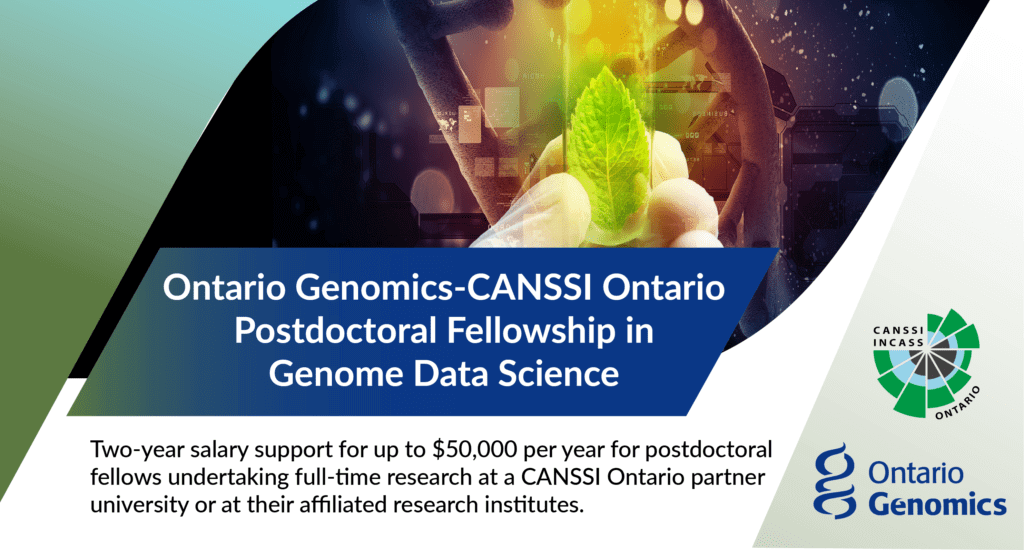
Ontario Genomics-CANSSI Ontario Postdoctoral Fellowship in Genome Data Science

Ontario Genomics-CANSSI Ontario Postdoctoral Fellowship in Genome Data Science

June 15, 2022: We are pleased to announce a new joint funding opportunity from Ontario Genomics and CANSSI Ontario, the Ontario regional centre of the Canadian Statistical Sciences Institute, establishing another joint Postdoctoral Fellowship in Genome Data Science.

This Fellowship will support the work of an early-career investigator pursuing research in the areas of statistical genetics, environmental genetics, or the economics and impacts of genomic technologies, in a climate changing world.

We seek to support research projects that focus on statistical methodology and tool development, including computational tools. We encourage applications from candidates combining \’omics data with other data to overcome challenges, especially as it applies to the environment and climate change.

Research projects of particular interest are those that:

  • Bridge data from the lab into the real world (commercial or governmental applications);
  • Develop tools and link datasets in meaningful ways for policy development and implementation; and
  • Establish frameworks and methods that allow consistent comparison of results, and that give an understanding of the limitations and opportunities.

Examples include:

  • Methods and tools to address climate change, food systems, and sustainability.
  • Methods and tools to address biodiversity, reflecting localized data and values.
  • Life cycle inventory and analysis of data that can be used to support the circular bioeconomy.
  • Robust methods that incorporate the diversity of populations and data.

The Fellowship offers two-year salary support for up to $50,000 per year for postdoctoral fellows undertaking full-time research at a CANSSI Ontario partner university or their affiliated research institutes. Candidates are responsible for selecting, contacting, and securing the commitment of two faculty members to jointly supervise them in their project, one being a statistical geneticist, genetic epidemiologist, or environmental epidemiologist.

Funding Availability: Up to two years.
Maximum Fellowship Value: $50,000 per year for up to $100,000 over 2 years.

Call for Applications Opens July 5, 2022.


About

Ontario Genomics is a not-for-profit organization leading the application of genomics-based solutions to drive economic growth, improved quality of life and global leadership for Ontario. Ontario Genomics plays a vital role in advancing projects and programs by supporting the development of their proposals, helping them access diverse funding sources, and finding the right industry partners to take this research out of the lab to apply it to the world’s most pressing challenges. Since its inception in 2000, Ontario Genomics has raised more than $1.27 billion for genomics applied research in Ontario and directly supported more than 9,100 trainees and jobs. We have 110+ active projects, 500+ impactful partnerships and have secured $1.34 billion in follow-on investments.

CANSSI Ontario is the Ontario regional centre of CANSSI–a national institute offering the leadership and infrastructure necessary to increase and further develop statistical sciences research in Canada and promote the discipline. CANSSI Ontario seeks to support data-intensive, interdisciplinary research and strengthen the network of statistical and data scientists in Ontario and across Canada. www.canssiontario.utoronto.ca.


Contact:
Ontario Genomics
Michael Dorrington, Manager, Strategic Partnerships
Telephone: 416.673.6562
Email: mdorrington@OntarioGenomics.ca

CANSSI Ontario
Esther Berzunza, Program Manager
Telephone: 416-689-7271
Email: esther.berzunza@utoronto.ca

Investing in the Future of Food with $900k+ in Funding for Cellular Agriculture

AcCELLerate-ON, Canada’s first regional cellular agriculture competition, funds four cutting edge cellular agriculture-focused food and beverage projects

Toronto, May 3, 2022—The Canadian Food Innovation Network (CFIN) and Ontario Genomics have announced the recipients of more than $900K in funding through their AcCELLerate-ON competition. AcCELLerate-ON is Canada’s first regional cellular agriculture competition, supporting the research and development of novel and innovative viable food production methods with the intent to drive economic growth and Ontario’s global leadership in this new and sustainable way to produce food.

The four genomics and engineering biology projects were chosen for their potential to drive food innovation, address industry opportunities, solve challenges, and benefit the cellular agriculture ecosystem and food and beverage industry in Ontario.

The AcCELLerate-ON funding recipients are:

  • Ardra Inc.: Developing fermentation-based production of heme as a natural flavour ingredient
  • Cell Ag Tech: Scaling up the manufacturing of fish muscle stem cells from a 2D to 3D culture system with proteomic assessments of the cells
  • Evolved (formerly Caro Meats): Creating cultivated pork belly that is identical to conventional pork belly
  • The University of Toronto, Dr. Michael Garton in collaboration with MyoPalate: Establishing the foundational tools for cultivated pork production

An ever-increasing global population, alongside the negative effects of climate change on food production, will lead to an expected 76 per cent increase in food requirements by 2050. To meet this demand, current food production methods must be supplemented by novel and innovative food production techniques.

Cellular agriculture encompasses several innovative approaches that use cell cultures, tissue-engineering, or precision fermentation-based techniques to create a variety of products that have been traditionally produced through conventional production mechanisms. These cutting-edge technologies offer a unique opportunity to help meet this global food demand while providing significant environmental and economic benefits.

According to the 2021 Ontario Genomics report, , Canada has a significant opportunity on the horizon with scenarios suggesting a $7.5 billion a year industry and up to 86,000 jobs created by 2030. Longer term, the industry has the potential to reach $12.5 billion a year with the creation of up to 142,000 jobs.

The successful projects are jointly funded by Ontario Genomics and CFIN and will be completed within 12-18 months.

QUOTES

“Developing a cellular agriculture ecosystem is essential to expanding Canada’s ability to meet the growing food demand around the globe and to accelerate innovation in the food production sector. Through the AcCELLerate-ON program, we are building a stronger, more sustainable future for Canadians.”
– The Honourable François-Philippe Champagne
Minister of Innovation, Science and Industry

“It is very clear that cellular agriculture is garnering the interest and dollars of the global investor community. Today’s announcement will help Ontario’s most innovative food start-ups and researchers get to the next level by supporting product development, job creation and revenue generation. By leveraging our existing strengths, this partnership between CFIN and Ontario Genomics is a critical step to growing Ontario’s cellular agriculture ecosystem.”
– Dr. Bettina Hamelin
President and CEO, Ontario Genomics

“Transformative innovation is the only way we can solve global food challenges. These four homegrown projects represent a unique and sustainable approach to feeding a growing global population while demonstrating the potential of Canadian food innovation.”
– Joseph Lake
CEO, Canadian Food Innovation Network

Ontario Students can now Learn about Genomics Innovations in the Agri-Food Sector

April 27, 2022 – As part of the Ontario Regional Priorities Partnership Program (ON-RP3), Ontario Genomics (OG), the Agricultural Adaptation Council (AAC), and Genome Canada (GC) are bringing the role of genomics innovation in advancing Ontario’s agri-food sector to centre stage through innovative education programs with Farm & Food Care Ontario and AgScape.

Under Farm & Food Care Ontario’s FarmFood360 video series, five videos were created to engage the public on the role of genomics in agri-food and how it can help address food security, climate change, and animal welfare. The video series also features a 360° virtual reality-enabled tour of the state-of-the-art Elora Dairy Research Centre.

With AgScape, new educational materials ‘An Exploration of Genomics in Agriculture and Food’ were created with a Teacher’s Guide for Grades 7-12. Developed by Ontario certified teachers and food literacy experts at AgScape, with additional support through the experts at Ontario Genomics, this resource for Ontario teachers provides engaging lessons and activities to educate students on the role genomics plays in agri-food innovation and a variety of related career paths students could explore.

“We have already received great feedback from teachers across Ontario who said that this resource has filled an important gap within the curriculum in terms of addressing the importance of agriculture and food genomics to food security, food safety and climate change.” Said Mercedes Unwin, Program & Resource Manager with AgScape. “Thanks to this collaboration, teachers now feel equipped with a broader knowledge on the subject on top of having easy to use and accessible lesson plans that can be delivered to their students”.

Developed based on the six strategic priority areas for genomics-based research and innovations identified in Ontario Genomics’ report Genomics for Agriculture & Agri-Food: Ontario’s Strategic Opportunity, the aim of ON-RP3 was to drive genomics innovations targeted at advancing Ontario’s agri-food sector. Through an investment of $2.95 million, eight proof-of-concept projects were co-led by industry and academic alliances. Projects were supported based on industry identified challenges and opportunities, branching across agricultural sub-sectors such as grain farming, livestock, food processing and craft brewing.

The partnered investment from AAC, OG and GC also sought to support a public outreach initiative, broadly communicating the work done by the teams through education and outreach. Through this initiative, partnerships with Farm & Food Care Ontario and AgScape were formed, focusing on public education around the key role that genomics plays in advancing the Ontario agri-food sector.

“AAC was thrilled at the opportunity to partner with Ontario Genomics as well as two of our member organizations, Farm & Food Care Ontario and AgScape, on a public outreach initiative that targets Ontario’s youth,” said Melanie DiReto, AAC Executive Director. “Through the strategic investment in the ON-RP3 initiative, AAC is excited to support the development of innovative outreach materials to educate youth on the role genomics plays in the agri-food sector.”

“It is vital that students have access to quality educational resources explaining where their food comes from and how science is helping build a better food system,” said Bettina Hamelin, President & CEO of Ontario Genomics. “We were delighted to work with the dedicated teams at AAC, AgScape and Farm & Food Care to bring this ground-breaking science into the classroom and shed light on the amazing genomics research happening across Ontario.”


For more information, please contact:

Polina Martins
Director of Communications, Ontario Genomics
pmartins@ontariogenomics.ca

Erin Genge
Program Coordinator, AAC
egenge@adaptcouncil.org

Investment in Genomics-led Precision Health Initiative Delivers Rare Disease Diagnosis in Ontario

This study mining cancer genetics for targeted treatment options is an integral part of the All for One Canada-wide initiative geared towards providing equitable access to genome-wide sequencing for diagnosis and treatment of genetic disease.

Ontario Genomics is pleased to play an integral role in the All for One precision health initiative to advance a new standard of health care for Canadians, expanding access to genome-wide sequencing for diagnosis and treatment of life-threatening genetic diseases.

The $39 million All for One initiative includes $13 million in federal investment through Genome Canada and $26 million in co-funding from industry, health care organizations, provincial and other partners brought in through six regional Genome Centres, including Ontario Genomics.

As part of this initiative, CHEO and the Hospital for Sick Children (SickKids), in collaboration with the Ontario Ministry of Health are piloting an optimized clinical genome-wide sequencing service for patients with rare diseases in Ontario. This project is receiving $950,000 from Genome Canada, through Ontario Genomics.

Currently, more than one-third of the estimated 930,000 Ontarians with a rare disease lack a genetic diagnosis, despite lengthy and costly investigations. Advances in precision health—which harnesses the power of genome sequencing to diagnose and inform treatment of genetic conditions—are revolutionizing health care, but access to clinical genomic testing across Canada remains inconsistent, which was the case for most of Anna\’s life.

Genome-wide sequencing pilot project helps Ontario families get answers

Anna had a childhood filled with regular injuries as a result of persistent muscle weakness, with hundreds of doctor’s visits. Her clinical team at CHEO completed dozens of tests, including muscle biopsies, metabolic testing and at least five different genetic tests, but no conclusive diagnosis was reached.

Conventional genetic testing involves testing subsets of genes, often leading to multiple tests and investigations, which can present a complicated and time-consuming process for clinicians, patients and families. In contrast, Genome-Wide Sequencing can search all known genes for variants that could be disease-causing, providing a much more comprehensive look at a patient’s genetic data.

Isla had severe jaundice, skin rashes, extremely low energy, difficulty feeding and problems with growth associated with high levels of inflammation markers in her blood at just one week of age. She spent over a year in and out of SickKids with high fevers, infections, breathing issues and extreme acid reflux. Her clinical team addressed the symptoms while they searched to find the underlying cause, but tests to check her blood, bone marrow, immune system, DNA and more yielded nothing.

A diagnosis can often be the first step to accessing targeted care and for families, it can provide emotional relief and improved access to support and resources.

Isla was started on a biologic drug to reduce her inflammation levels with the hopes it would help address her other health issues. Still, her clinical team and her family wanted an explanation for all of Isla’s health concerns to help optimize treatment and prevent complications. Isla had exome sequencing as one of the last diagnostic options, which found a new DNA change in a gene called CDC42, which is known to cause severe inflammation. Armed with this knowledge, Isla’s family and clinical team were confident that their treatment plan was the right one.

Anna had genome sequencing as part of GSO’s quality improvement study to evaluate the benefit of interrogating the entire genome. GSO reported that she has a rare genetic condition because of two variants affecting a gene called SELENON. She inherited one variant from her mother and one from her father. Genome sequencing was critical to the identification of these variants in Anna as they were not detectable via the previous testing technologies and would not have been identified using exome sequencing. Although she is small for her age and her bone development is delayed, she takes swimming lessons, does her best to keep up with friends at recess, gets good grades and is an avid reader. Like any 12-year-old, she loves spending time on her tablet playing games. “More than I probably should,” Anna says.

“It took 12 years to finally put a name to what Anna was experiencing every day since she was an infant. When we got the genome sequencing results and diagnosis, it was the first time in 12 years that we were able to read something with a name on it and say, ‘That’s it! That’s what we’ve been dealing with,’” said Mallory Boileau, Anna’s mother. “It would be great for families to get this type of answer at the beginning of their journey. Twelve years is a long road not to have answers.”

Now, Anna’s family and care team can keep an eye out for potential complications that are associated with her diagnosis. Mallory says, “The not knowing is sometimes more terrifying than anything. We’re no longer guessing all the time and can address things before they become an issue. It’s such a relief.”

Isla’s family is thankful, too. “After Isla started her treatment, you could tell how much better she was feeling. Isla started to have more energy and began smiling and even laughing,” says Miki Simmons, Isla’s mother. “At four years old, Isla’s keeping up with all her older siblings and I’m not sure where we would be if we didn’t have the treatment plan and diagnostic answers that we did when she was a baby.”

“Early diagnosis of rare diseases at the molecular level is vital to shorten the diagnostic journey of rare disease patients, like Anna and Isla, and make sure they can access appropriate care as soon as possible. This partnership uses genomics tools to inform provincial and cross-provincial policies that improve rare disease diagnosis and quality of life.” – Dr. Bettina Hamelin, President and CEO, Ontario Genomics

This project advances a new standard of health care for Ontarians and Canadians, expanding access to genome-wide sequencing for diagnosis and treatment of life-threatening genetic diseases.

“Our government is proud to support this pilot with CHEO and SickKids, which is already helping Ontario families just one year into implementation. This promising project will improve patient outcomes by providing timely access to genetic diagnoses, which is another way Ontario is building a better-connected health-care system, centred on the needs of patients.” – Christine Elliott, Ontario’s Deputy Premier and Minister of Health

With pan-Canadian reach and strong partnership from provincial and regional health services authorities, All for One will be a core building block of a coordinated human health genomics ecosystem in Canada, bridging clinical care and cutting-edge research.


Partner Quotes

“Quick access to comprehensive genetic testing, like exome or genome sequencing, must be a cornerstone of health care for children and youth who have suspected, but undiagnosed, genetic conditions. With GSO, not only are we able to provide this testing, but we’re also preparing for the future when genome sequencing may become the new standard-of-care clinical test for these patients. This pilot is another step in the path to achieve SickKids’ vision of Precision Child Health, where every patient and family receives individualized care.” – Dr. Martin Somerville, Division Head of Genome Diagnostics, SickKids

“For parents like Anna’s, there is an unbelievable and largely unseen stress that goes with not knowing what is causing their child’s condition. Along with this stress is a desperate desire to find answers and do the best thing for them. And having that uncertainty linger for years and years is such a burden. As clinicians, we want to provide more certainty to these families as soon as possible. We hope the findings from our project will bring that possibility closer to a reality.” – Dr. Kym Boycott, Chair, Department of Genetics, CHEO


About Ontario Genomics

Established in 2000, Ontario Genomics (OG) is a not-for-profit organization leading the application of genomics-based solutions to drive economic growth, improved quality of life and global leadership for Ontario. Ontario Genomics plays a vital role in advancing projects and programs like wastewater surveillance by supporting the development of their proposals, helping them access diverse funding sources, and finding the right industry partners to take this research out of the lab to apply it to the world’s most pressing challenges. Since its inception in 2000, Ontario Genomics has raised more than $1.27 billion for genomics applied research in Ontario and directly supported more than 9,100 trainees and jobs. We have 110+ active projects, 500+ impactful partnerships and have secured $1.34 billion in follow-on investments.